Step 1: Test Your Battery Voltage
Before submitting a warranty claim, test your battery's voltage with a multimeter. This helps us diagnose the issue faster and determines whether the battery needs replacement or if the problem is elsewhere in the electrical system.
What You Need
A basic digital multimeter — available at any hardware store for $15-20. This is an essential tool for any eBike owner.
How to Test
- Fully charge your battery until the charger light turns green. Then unplug the charger and let the battery rest for 30-60 minutes. This allows the chemistry to stabilize for an accurate reading.
- Remove the battery from the bike frame.
- Set your multimeter to DC Voltage — look for the symbol with a V and a straight line. If your multimeter has multiple ranges, select 200V.
- Locate the main discharge connector on the bottom of the battery — this is the large plug that connects to the bike frame, NOT the small charging port.
- Connect the probes — insert the RED probe into the positive (+) terminal and the BLACK probe into the negative (-) terminal. Hold firmly.
- Read the voltage on the multimeter display.
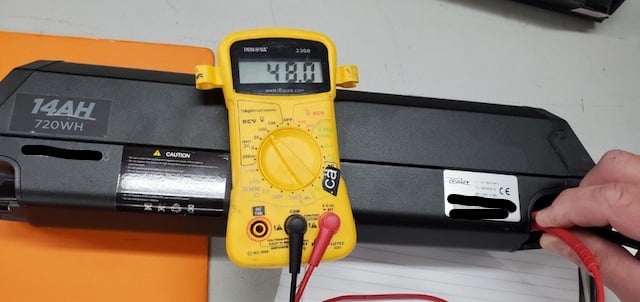
Place the red probe on positive (+) and black probe on negative (-) terminal of the main battery discharge connector.
Understanding Your Voltage Reading
All Surface 604 eBikes use a 48V 20Ah (960Wh) lithium-ion battery with 13 cells in series. Here's what your reading means:
| Voltage Reading | Battery Status | What To Do |
|---|
| 52.0V – 54.6V | Fully charged, healthy | Battery is working correctly. Issue may be elsewhere (controller, torque sensor, wiring). |
| 48.0V – 52.0V | Partially charged | Charge fully and retest. If it reaches 52V+, the battery is healthy. |
| 42.0V – 48.0V | Low charge | Battery needs charging. Charge immediately — leaving lithium batteries at low voltage damages cells permanently. |
| 36.0V – 42.0V | Critically low / degraded cells | Charge immediately for 8+ hours. If it won't charge above 48V after a full charge cycle, the cells are degraded. Contact support. |
| Below 36V | Dead cells or BMS failure | Battery cells are likely beyond recovery. A replacement battery is needed. |
| 0V | Internal fuse blown or BMS shutdown | The Battery Management System has shut down to protect the cells, or an internal fuse has blown. Contact support — this may be repairable. |
Important Notes
- Never let the multimeter probes touch each other while connected to the battery — this causes a short circuit.
- "54.6V" is the true full charge — even though it's called a "48V" battery, 54.6V is 100% charged (13 cells x 4.2V per cell).
- If your charger shows green immediately (as if fully charged) but the battery reads below 42V, the cells have degraded to the point where they can't accept a charge. The battery needs replacement.
- Test under load too — a battery may show 52V at rest but drop sharply when you engage the motor. If voltage drops more than 5V when you briefly engage the throttle (with the rear wheel off the ground), the cells have high internal resistance and are degraded.
Step 2: Check Your Charger
Sometimes the problem isn't the battery — it's the charger. Test your charger by measuring its output voltage:
- Set your multimeter to DC Voltage (200V range).
- Plug the charger into the wall (but NOT into the battery).
- Touch the multimeter probes to the charger's output connector terminals.
- A working 48V charger should output approximately 54.6V.
- If the charger outputs significantly less than 54V, or outputs 0V, the charger is faulty and needs replacement.
Step 3: Battery Care Tips to Prevent Issues
- Never let your battery drain to 0%. Deep discharge permanently damages lithium-ion cells. Recharge when the display shows 20% or lower.
- Charge every 30 days during winter storage or any period of non-use. A battery left uncharged for months will self-discharge and cells may die.
- Store at 50-60% charge — not fully charged and not empty. This is the optimal storage voltage for lithium-ion longevity.
- Store in a cool, dry place — avoid extreme heat (garages in summer) and freezing temperatures (unheated sheds in winter).
- Keep the battery warm before riding in cold weather. Cold cells deliver less power and less range. Store indoors and install just before riding.
- Don't charge immediately after riding. Wait 30 minutes for the battery to cool down before plugging in the charger.
Step 4: Submit a Warranty Claim
If your battery is within the warranty period and your voltage test confirms a problem, submit a warranty claim through our online form:
Submit Battery Warranty Claim →
You will need:
- Battery serial number (printed on the battery label)
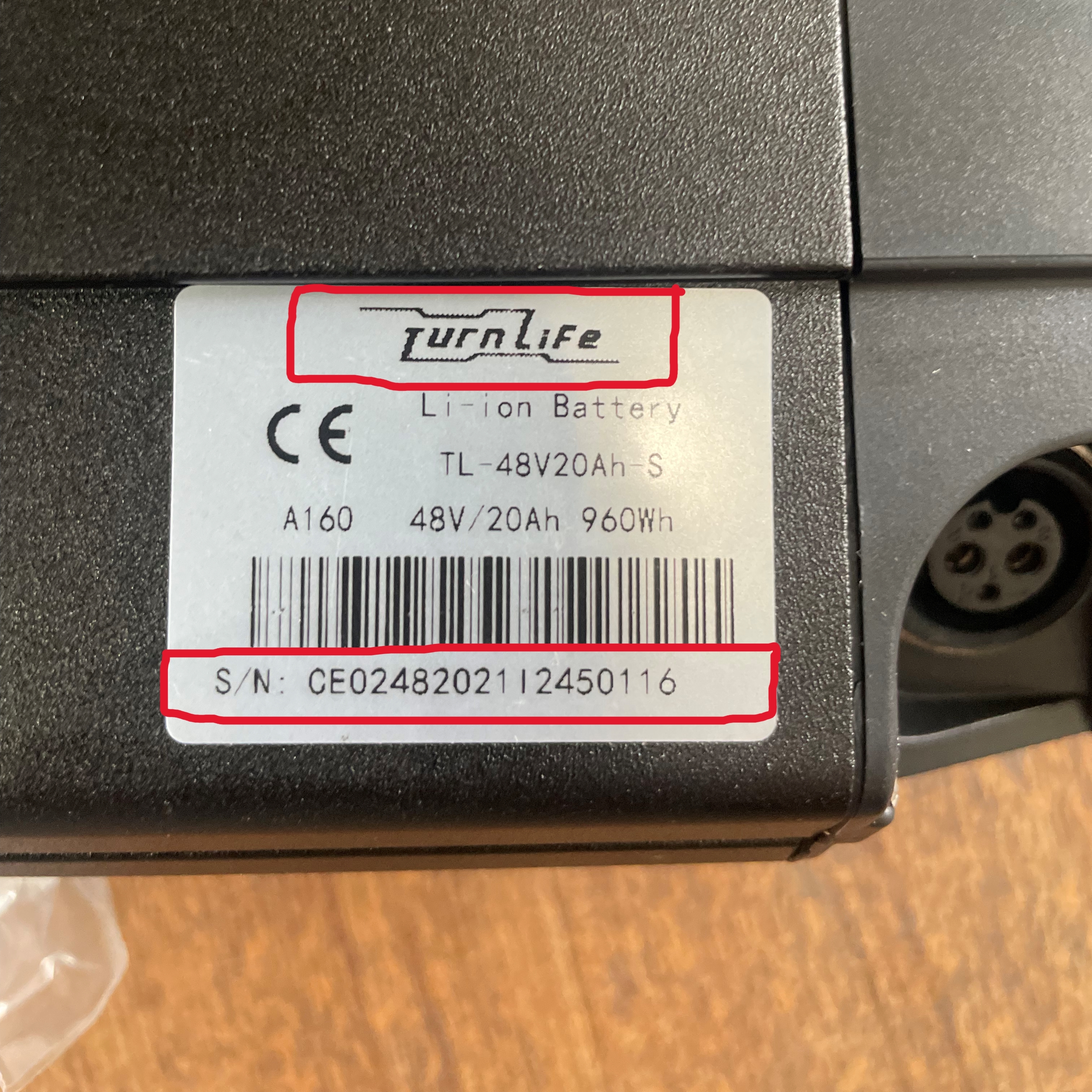
Your battery serial number is printed on the label on the side of the battery pack.
- Photo of your multimeter showing the voltage reading
- Proof of purchase (order number or receipt with date)
- Description of the issue
Once submitted, our team will review your claim and provide next steps within 3-5 business days. If a replacement is needed, we'll ship it directly to you.
Need a Replacement Battery?
If your battery is out of warranty or you'd like to purchase a replacement, visit our Batteries & Chargers page. All Surface 604 batteries are 48V 20Ah (960Wh), UL 2271 certified.
